


Stay safe when severe weather sounds the sirens
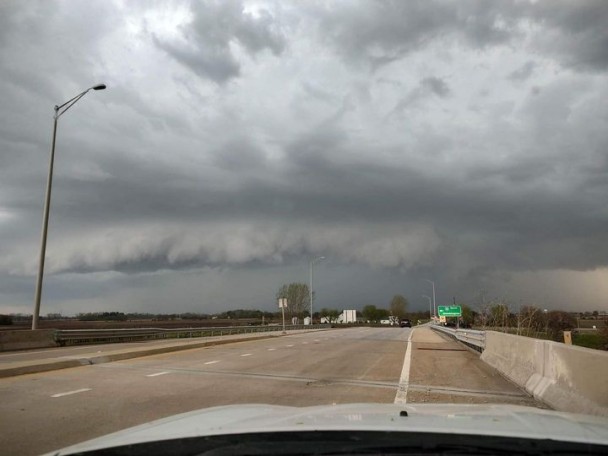
BRAIDWOOD ESDA KEEPS an eye out for hazardous weather, like this storm that rolled through last week dropping pea sized hail across the region. ESDA photo.
Braidwood’s Emergency Services adn Disaster Agency (ESDA) issued a few alerts over the past few days, but rather than rain and storms, this time is was cold that had the agency looking out for the public, notifying residents of potential freeze conditions.
ESDA is charged with keeping the public informed during potential dangerous situations, including inclement weather.
We asked ESDA Coordinator Josh Bolatto for some tips and information on preparing for severe weather this spring. Here, the second part of our series on staying safe when Mother Nature turns a little bit wicked:
What do I do if I am outside and sirens go off, meaning I am not necessarily close to home (walking the dog for instance) or in my car?
If possible, get inside a substantial building on the lowest floor, away from windows and doors. If an indoor shelter is not available or there is no time to get indoors, then, as a last resort, lie in a ditch or culvert. Use your arms to protect your head and neck. Beware of the potential for flash flooding.
If in a vehicle, do NOT park under a bridge or overpass! The embankment under an overpass is higher than the surrounding terrain, and the wind speed increases with height. Additionally, the overpass design may create a wind-tunnel effect under the span, further increasing the wind speed. Many overpasses are completely exposed underneath, and most lack hanging girders or a crawlspace-like area to provide sufficient protection from debris, which can travel at high speeds even in weak tornadoes. People stopping underneath overpasses block the flow of traffic, putting others in danger. Immediately exit the vehicle in a safe manner and take shelter in a nearby building. Never try to outrun a tornado in a vehicle. Heavy rain, hail and traffic may impede your movement. Tornadoes can change directions quickly and can easily lift up a vehicle and toss it through the air. As a last resort, if there isn’t time to get indoors or if there is no secure shelter nearby, lie flat in a ditch, culvert or low-lying area away from vehicles.
During a Severe Thunderstorm, if outdoors, seek shelter immediately. If you can hear thunder, you are close enough to the storm to be struck by lightning. If you find yourself in a position where there is no immediate shelter available, find a low spot away from trees and power poles. If you are in a boat when a thunderstorm threatens, you should attempt to reach shore as quickly as possible. Get off of golf courses, sports fields, and out of swimming pools. If you are driving, pull safely to the shoulder away from trees and power lines. Lightning can flash from trees or power poles and strike a vehicle. Rubber tires do NOT keep lightning from striking a vehicle. In the open, a hard-topped vehicle is normally a safe shelter from lightning. Avoid touching metal parts of the vehicle when lightning is nearby
What do I do if power lines go down near my house?
So, this answer is a little broader on what to do after a tornado or severe thunderstorm.
Monitor local radio or TV or contact your local emergency management agency for special information about where to go to get assistance for housing, clothing and food. Programs are available to help you cope with the stress of the disaster. Use extreme care in areas with downed power lines or natural gas leaks. Wear adequate footwear to avoid cuts from broken glass or nails protruding from boards. Check for injured victims. Render first aid if necessary. Do not attempt to move severely injured victims unless absolutely necessary. Wait for emergency medical assistance to arrive. Check on neighbors or relatives who may require special assistance.
Exit damaged buildings. Re-enter only if absolutely necessary using great caution. Have the damaged building inspected by a structural engineer to make sure it is safe to occupy. If driving, be alert for hazards on the roadway. Do not make unnecessary telephone calls. Take photos or video of the damage to your home and property and report it to the local emergency management agency. If unaffected by the tornado, stay out of the damaged area until local officials allow entry. Your presence will hamper emergency operations.
Any information you want to add about severe weather preparedness and how people can stay safe?
There are always questions about the outdoor warning sirens and the criteria to activate them. So, in Braidwood, when can the sirens be activated?
1) If a tornado warning is issued from the National Weather Service for the area which includes the Braidwood Community;
2) If a funnel or tornado has been spotted near the Braidwood community and heading in the direction of the city (with or without an official warning issued by the NWS);
3) Sustained winds greater than 65mph (straight line winds, microbursts, downbursts). These can do a lot of damage to property or harm to individuals who are outdoors.
4) In the unlikely event of a nuclear accident at the Exelon Generation Braidwood Nuclear Power Station.
One of the biggest misconceptions is that sirens in our area are activated just for tornadoes, which is FALSE. They are actually called “Outdoor Warning Sirens’ and NOT only for tornado purposes, like many assume. If there is any threat to life and/or property due to natural or a man-made disaster, the sirens can be activated. There is no difference in the tone or pitch of the siren based on the nature of the incident for which they have been activated.
Many people complain they cannot hear the sirens while inside their home, a garage or a vehicle. That’s because they are meant for those who are outdoors, hence the term "Outdoor Warning Sirens". Many factors come into play which make it difficult or impossible to hear the outdoor warning sirens while inside a structure, home or even a vehicle. Types of construction, soundproofing building or insulation materials, vehicle traffic, interior noises such as a TV, radio, air conditioning unit, furnace, fan, casual conversation, etc. are just some of those contributing factors. You should never expect to hear them while inside a building or vehicle.
You should not wait for, or rely on, hearing the outdoor sirens before seeking shelter in a severe weather event. Also, just because the siren stops does not mean you are in the clear. During a severe weather incident, you should immediately go to a NOAA weather radio or other source to see what warning is actually occurring and for how long. The sirens are NOT re-activated to give an all clear.
Remember, sirens are for OUTDOOR warning purposes and are not meant to be heard indoors. If you hear a siren, head indoors immediately and seek additional information.
For the City of Braidwood and Will County, you can tune to one of the following radio stations for the latest information and possible emergency instructions:
WCCQ 98.3 FM
WRXQ 100.7 FM
WSSR 96.7 FM
WJOL 1340 AM
It does NOT mean the threat has ended when the sirens stop. Sirens are activated by the Will County Emergency Management Agency and The Public Service Answering Point (PSAP or 9-1-1 dispatch center) serving the Braidwood Community, not the National Weather Service. There is also no local controller within the City of Braidwood to activate the sirens.
Will County conducts a monthly test of the Outdoor Warning Sirens in accordance with Illinois Law which requires tests to be conducted at 10:00 am on the first Tuesday of each month. In addition to the monthly activation test, each siren undergoes a weekly “growl test” in which a siren start signal is sent to the siren causing the head of the siren rotates and emit a very low noise which usually isn’t even heard by those nearby. Each siren also undergoes a silent test every weekday, excluding holidays, to ensure communications between the receiver and the siren controller system. If a siren fails one of the above tests, a report is immediately sent to Constellation and Will County EMA. Each siren in our area also has a battery backup in the event of a power loss to the unit.
Should the Outdoor Warning Sirens activate at any time other than the monthly test, you can tune to one of local radio stations listed above
Outdoor warning sirens are starting to be considered more of an antiquated system which is subject to several factors (human error, computer/controller malfunctions, hardware failure, etc.) which can cause errors, malfunctions, false activations, etc.
Outdoor warning siren locations in the immediate area of the City of Braidwood These sirens are within the jurisdiction of Will County. There are additional sirens in the area which may fall under the jurisdiction of neighboring Grundy or Kankakee Counties.
1) West side of Greer Road, North of Frontage Road (alongside of I-55)
2) Braidwood Fire Station (SE Corner of Main and School Street)
3) East of I-55 at the Reed Road Interchange
4) East side of Essex Road, 3⁄4 mile south of RT 113
5) West side of Zilm Road, 1⁄2 mile North of McGuire Rd
6) Darby Rd/County Line Road
7) NE corner of Dondanville/Kankakee Rd
All outdoor warning sirens system in our area, which are part of the 10 Mile Emergency Planning Zone (EPZ) for either the Braidwood or Dresden Nuclear Power Plants, are owned and maintained 100% by Constellation who allows for access and use of the system by agreement with Will County and other counties within the EPZs. All sirens meet the auditable and decibel standards as set forth in the FEMA Radiological Emergency Preparedness Program Manual which states that in population areas with density of 2,000 people per square miles a minimum of 70 dB. In less populated areas, it can be acceptable to be at 60 dB.
When it comes to the distance between sirens, the guidance does not specify a specific distance between sirens. Rather it looks at the overall sound level. For example, things like terrain and building density can impact sound disbursement. That is why they look at sound level rather than specific distances.
Some people ask if more outdoor warning sirens can be added to the system for a specific location. The answer to this is possibly, but no guarantees. Constellation spends a lot of money to engineer and maintain an outdoor siren system that complies with 44 CFR Part 350/NUREG-0654/FEMA-REP-1/FEMA REP Program Manual. Typically speaking, it would need to be demonstrated that an outdoor siren does not perform as designed at a specific spot inside of the EPZ. That is typically demonstrated with a volume test during the regular monthly siren tests using frequency detection equipment by Constellation’s siren vendor.
Category:
815 476-7966 | 111 S. Water Street, Wilmington, IL 60481
