


Fourth of July somewhere over there
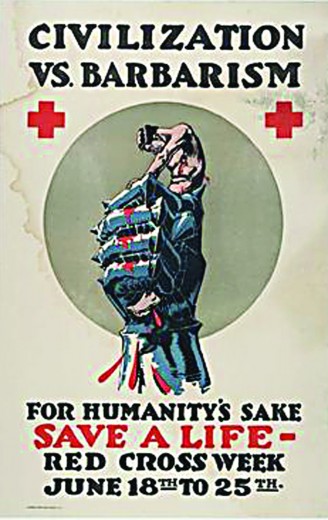
One hundred years ago Fourth of July celebrations were being held in places that had never seen an American flag before. As more and more “Sammies” arrived in Europe it was becoming a familiar sight.
In France, young Ronald Jardine of Wilmington was working in a hospital but thinking of home. He wrote home to his mother telling her how it was over there.
France, July 4, 1917
Dear Mother and Folks, Just a few words in the mail this morning before I go back to work. Received both your letters OK.
“Our hospital has over 2,000 beds instead of 500 as contemplated. Of course, it's not always full. In fact, it never has been completely occupied, but it is more full in the summer than in the winter because of the heavier fighting at the front during warm weather.
“Our ward holds 30 patients. We have had 26 at a time. They keep going out of hospital to “Blighty,” that's what the English soldiers call England, and they keep coming in from the front. When a convoy comes in, that is a train of wounded, we have to get up out of bed and distribute the stretchers around the wards, no matter what time of night it is.
“Last week there was heavy fighting at the front and we had a convoy every night but one, and one or two days we had two. The average number in a convoy is about 100 stretchers, and 80 or 100 “walking cases.” Those are fellows whose wounds do not necessitate their being carried on stretchers.
“I groaned when I heard of Joe Cerveny's death. He was some fine young fellow, and had ambition that few boys have I think. Sad that Frankie Drumm had to die so early in life.
“Thursday, July 5 - Didn't have time to finish up yesterday a.m. and so I'll try this a.m. instead.
Yesterday was the Fourth, but it hardly seemed like the Fourth of July, I celebrated by working all day. In the evening at six o'clock all our boys joined in a big dinner. That was the extent of my celebration.
“I am making a collection of war relics and badges. I have many kinds of bullets, a belt taken off from a dead German, several kinds of uniform buttons, badges and so on. I got a Scotch badge yesterday. It's a beaut.
“We now have several English, Scotch, Irish, Austrians, Canadians and New Zealanders in our ward. It is quite an experience to talk with them. You never meet one that is anxious to go back to the front.
“We are expecting a visit from the king and queen of England today.
“Write and give as much news as possible about boys enlisting, etc. Am fine at present. Lovingly, your son, Ronald.”
Back at home, Wilmington's celebration was held at the Ryan Bros. Race track, north of town on Kankakee Street, where it is estimated 3,000 people gathered to celebrate the day. It had two main features, first the horse racing.
Almost all of the horses racing were local and of course the betting was heavy.
The second feature was an automobile parade. We read in the Advocate, “In the automobile parade, Eno Johnson's car fitted up as a submarine was awarded first money M. Melcher, the undertaker, won second money with his auto funeral car as a Red Cross ambulance, upon which the Misses Edna Flood and Blanch Young rode dressed in Red Cross uniforms.
“The music was furnished by the Wilmington band, and over 550 automobiles were on the race grounds.”
In that same issue we read the following, “William Davy, Jr. who has been working for some time past in Cleveland, O., returned to his home here last week to make his parents a visit. Thursday, he enlisted, was examined and passed. Today he went to Chicago to either join the artillery or the aviation corps.”
There was no doubt in anyone's mind that holiday that the worst was yet to come. And they were right.
Category:
815 476-7966 | 111 S. Water Street, Wilmington, IL 60481
